Tuesday, 8 June 2010

FINAL SEMESTER
Having had a meeting with the external examiner yesterday (Ian Noble) it was encouraging to hear that he enjoyed watching the cine film footage I produced for the final work in semester 2.
We discussed where I was going next with my final dissertation and I explained that I was unsure if I should carry on with the Cine Filming or go in a different direction and try something else I have been thinking about for the last few weeks. "Hand Made" was an idea I have been thinking about for a few weeks now where by all the work (practical and written) would be undertaken without the aid of technology. No computers, faxes, photocopiers, emails or printers. It would be back to the days of magic markers, drawing boards, CS10, typewriters - back to the traditional "craft" of true Graphic Design.
Although this sounds very exciting and I must admit I was very enthused by it. I would be setting myself up for a great big fall and it would be open to a very big caveat "due to the process involved - I was unable to finish this project"!
Because of the big unknown within this brief and after speaking with Ian I am warming to the idea of putting a true narrative to a piece of cine film and re producing a poem, story or book. More though will be going into this self directed project over the next few days and I will hopefully have a clearer picture of what it is I will be pursuing for my next and final semester (dissertation).
We have our first group meeting tomorrow with Lawrence to discuss the final dissertation and what is expected of the project. This will hopefully again help to fine tune the project?
We discussed where I was going next with my final dissertation and I explained that I was unsure if I should carry on with the Cine Filming or go in a different direction and try something else I have been thinking about for the last few weeks. "Hand Made" was an idea I have been thinking about for a few weeks now where by all the work (practical and written) would be undertaken without the aid of technology. No computers, faxes, photocopiers, emails or printers. It would be back to the days of magic markers, drawing boards, CS10, typewriters - back to the traditional "craft" of true Graphic Design.
Although this sounds very exciting and I must admit I was very enthused by it. I would be setting myself up for a great big fall and it would be open to a very big caveat "due to the process involved - I was unable to finish this project"!
Because of the big unknown within this brief and after speaking with Ian I am warming to the idea of putting a true narrative to a piece of cine film and re producing a poem, story or book. More though will be going into this self directed project over the next few days and I will hopefully have a clearer picture of what it is I will be pursuing for my next and final semester (dissertation).
We have our first group meeting tomorrow with Lawrence to discuss the final dissertation and what is expected of the project. This will hopefully again help to fine tune the project?
Thursday, 27 May 2010
SOUP KITCHEN - SUNDAY 30th May
This coming Sunday 30th May (Bank Holiday) will see some of the work undertaken for my second semester main project being showcased at an acoustic event being held in the Norther Quarter at The Soup Kitchen.
There are between 8 and 9 live bands playing with myself and a chap called Joe Galen showing some visual footage to accompany the music. Should be a great day and it is good to actual show the work I have produced to an audience and not leave them locked away in a CD case.
If anyone reading this entry fancies popping along it starts at 5pm and is on until 11pm with FREE entry!!
There are between 8 and 9 live bands playing with myself and a chap called Joe Galen showing some visual footage to accompany the music. Should be a great day and it is good to actual show the work I have produced to an audience and not leave them locked away in a CD case.
If anyone reading this entry fancies popping along it starts at 5pm and is on until 11pm with FREE entry!!
Friday, 14 May 2010
FINAL PRACTICAL OUTCOME
I have today completed the final practical outcomes for my 2nd Semester project which has been focussing on memory and its effect through film.
Below are some of the shots taken of the DVD, cover and case.
This has been a real labour of love as I have encountered more problems that I would like to mention when writing the final hi-res mp4 files along with that the disaster of loosing my hard drive last week meant that I have been playing catch up.
1 hurdle over and just a couple more to go now. I am really pleased with the final films and the package as a whole.
Next on the list is the design boards which need to be completed by tomorrow afternoon (Saturday) so that they can be printed at the local printers.
Bring on next Friday when I can breath a sigh of relief!!!


Below are some of the shots taken of the DVD, cover and case.
This has been a real labour of love as I have encountered more problems that I would like to mention when writing the final hi-res mp4 files along with that the disaster of loosing my hard drive last week meant that I have been playing catch up.
1 hurdle over and just a couple more to go now. I am really pleased with the final films and the package as a whole.
Next on the list is the design boards which need to be completed by tomorrow afternoon (Saturday) so that they can be printed at the local printers.
Bring on next Friday when I can breath a sigh of relief!!!


Monday, 10 May 2010
A PICTURE A DAY
I made a decision right at the beginning of the second semester to take a photograph a day mainly on my iphone (as I always have it with me).
Today I have spent some time collating them images together and formulating them into some sort of order.
Below is a quick visual of all the images in chronological order (I think?) _ i will be re-checking the dates laster but felt I needed to put this on the blog as I get ever closer to hand in dates!!!
It was really interesting to look at these once they where all in position on the page - it almost maps out the time so far in this second semester in a very visual way.

Today I have spent some time collating them images together and formulating them into some sort of order.
Below is a quick visual of all the images in chronological order (I think?) _ i will be re-checking the dates laster but felt I needed to put this on the blog as I get ever closer to hand in dates!!!
It was really interesting to look at these once they where all in position on the page - it almost maps out the time so far in this second semester in a very visual way.

CINE IN THE WOODS
After lots of prep work and getting images from my mum which she has been digging out of shoe boxes for the last 3 weeks it was time to go on an adventure in the woods this weekend. With the disaster of loosing my hard drive on my lap top behind me it was time to focus on some positives within this project.
I set up a position to undertake the filming whilst there was still daylight, I needed to be in a position where a 200ft extension lead would reach, this was a little restricting to say the least (I am in negotiations with a friend re borrowing his small generator, the only issue I have with that is the noise (it was interesting last night to see the odd set of little eyes lighting up - don't think I will get that if there is a generator working at some ungodly decibeles!).
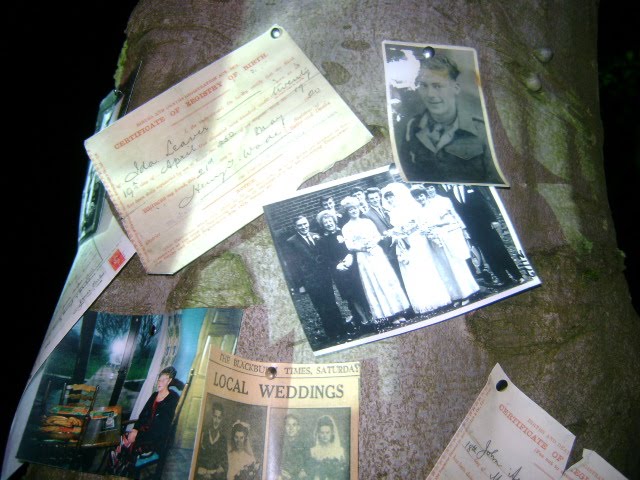
Anyway - I positioned all the images that I have managed to collect over 3 trees each one set back from the other to give a good depth of field. The projector was set up, lap top ready and digital camcorder in position. After approximately 45 mins last night at 1am I decided that I had enough footage to see if this was working.
Below is a series of still shot of the set up and some of the projections into the woods.


I set up a position to undertake the filming whilst there was still daylight, I needed to be in a position where a 200ft extension lead would reach, this was a little restricting to say the least (I am in negotiations with a friend re borrowing his small generator, the only issue I have with that is the noise (it was interesting last night to see the odd set of little eyes lighting up - don't think I will get that if there is a generator working at some ungodly decibeles!).
Anyway - I positioned all the images that I have managed to collect over 3 trees each one set back from the other to give a good depth of field. The projector was set up, lap top ready and digital camcorder in position. After approximately 45 mins last night at 1am I decided that I had enough footage to see if this was working.
Below is a series of still shot of the set up and some of the projections into the woods.


Saturday, 8 May 2010
MICHEL GONDRY - Camera Tricks!
I have been looking for an excuse to get Bjork on here somewhere - so here it is!!!!
Tuesday, 4 May 2010
VIRTUAL WORLDS
I am hoping to have a full set of components over the next 2 weeks to be able to build up a full mountain bike - (heres hoping!!!)


Below are some of the images created so far in the virtual worlds module.


Below are some of the images created so far in the virtual worlds module.


Monday, 3 May 2010
SHORT & LONG TERM MEMORIES IN THE BRAIN

Scientists at the University of California, San Diego have produced dramatic images of brain cells forming temporary and permanent connections in response to various stimuli, illustrating for the first time the structural changes between neurons in the brain that, many scientists have long believed, take place when we store short-term and long-term memories.
In a paper published in the November 30 issue of the journal Cell, researchers from UCSD's Divisions of Biology and Physical Sciences describe their achievement, a "Holy Grail" for neuroscientists who have long sought concrete evidence for how nerve connections in the brain are changed temporarily and permanently by our experiences.
"The long-term memories stored in our brain last our entire lives, so everybody had assumed that there must be lasting structural changes between neurons in the brain," says Michael A. Colicos, a postdoctoral fellow at UCSD and the lead author of the paper. "Although there's been a lot of suggestive evidence to indicate that this is the case, it's never before been directly observed."
"While most people assumed that some sort of rearrangement of nerve cell connections took place in the brain, this was extremely difficult to demonstrate experimentally," says Yukiko Goda, a professor of biology at UCSD who headed the research team, which included Michael J. Sailor, a professor of chemistry and biochemistry at UCSD, and Boyce E. Collins, a postdoctoral fellow in Sailor's lab. "Some investigators saw increases in the number of synapses in the brain in response to stimuli, while others saw no changes. There are a billion synapses in a cubic centimeter of brain tissue, so no one could tell for certain whether the statistical comparisons of synapse density between one sample and another showed a real increase."
To resolve this problem, the UCSD researchers focused their attention on individual nerve cells, specifically neurons from the hippocampus -- the portion of the human brain crucial to forming particular types of memory -- and filmed them as their synapses made new connections to other nerve cells in response to electrical impulses.
The ability of the scientists to do this without impairing the normal physiological functions of the cells depended on two new techniques implemented in Goda's lab to study synaptic connections. One was a method of visualizing the rods and filaments of actin -- the girders that make up the cytoskeleton, the internal skeleton of the cell. Using molecular biology techniques, fluorescent versions of actin were constructed and visualized as the neurons grew and changed shape to establish new connections.
The second development, which resulted from a collaboration between Goda and Sailor, was a method of stimulating nerve cells in a manner that mimicked their stimulation in the brain. This involved using the "photoconductive" properties of silicon in a way that allowed the researchers to deliver a short, high frequency burst of electricity to a specific area of a neuron on a silicon chip by simply shining light on that area. Light excitation in that area of the silicon created a narrow pathway through which Colicos and his colleagues could apply a tiny voltage below the chip to target the neuron.
"We stimulate these cells with a short, high-frequency burst," says Colicos, working in Goda's lab. "That type of stimulation is what other researchers believed for many years was the type that formed these connections between neurons."
A key advantage of this method is that it doesn't damage the cell. "Part of the reason people haven't been able to demonstrate this before is that the technology hasn't been available to do this before," says Colicos. "The standard way of stimulating a neuron is to use an electrode. But as soon as you stab the cell with an electrode, it begins to die. So the advantage of this new technique is that we can keep the cells in their physiologically normal state. And when we stimulate the cells of our choice by shining light, we can induce the actual structural changes that occur in the brain -- the formation of these new synapses."
In their experiments, the UCSD researchers discovered that when they stimulated a cell once, the actin inside the cell was activated and temporarily moved toward neurons to which they were connected. The activity in the first cell also stimulated the movement of actin in neighboring neurons, which moved away from the activated cell. Those changes in the cells were temporary, however, lasting for about three to five minutes and disappearing within five to 10 minutes.
"The short-term changes are just part of the normal way the nerve cells talk to each other," says Colicos. "The long-term changes in the neurons occur only after the neurons are stimulated four times over the course of an hour. The synapse will actually split and new synapses will form, producing a permanent change that will presumably last for the rest of your life."
"The analogy to human memory is that when you see or hear something once, it might stick in your mind for a few minutes. If it's not important, it fades away and you forget it 10 minutes later. But if you see or hear it again and this keeps happening over the next hour, you are going to remember it for a much longer time. And things that are repeated many times can be remembered for an entire lifetime."
"It's like a piano lesson," says Goda. "If you play a musical score over and over again, it becomes ingrained in your memory."
In their experiments, which were financed in part by grants from the National Science Foundation and the National Institutes of Health, the researchers observed no changes in these newly formed nerve connections once they were established, indicating that they were permanent.
"Once you take an axon and form two new connections, those connections are very stable and there's no reason to believe that they'll go away," says Colicos. "That's the kind of change one would envision lasting a whole lifetime."
Wednesday, 28 April 2010
Experimental Cine Film
The film below is a short experiment that I have been playing around with after reading repots on colour memory. I have used acrylic paints and scratched some white end of cine super 8 film. The film was also left on a radiator at home to speed up the process with some interesting effects.
This piece was finding ways to utilise the scrap film that was left from an old cine film I purchased off ebay.
This exercise had made me think of other experimental ways I can produce footage that relates to memory.
This piece was finding ways to utilise the scrap film that was left from an old cine film I purchased off ebay.
This exercise had made me think of other experimental ways I can produce footage that relates to memory.
Abstract cine film painted (memory in colour) from Dave Howarth on Vimeo.
Thursday, 22 April 2010
influence technology has had on the graphic design industry.
influence technology has had on the graphic design industry.
Just something I came across whilst researching journals and reports on Technology and The Graphic Design Industry.
Just something I came across whilst researching journals and reports on Technology and The Graphic Design Industry.
DESIGN INDUSTRY & PROFESSIONAL PRACTICE
Today I have tasked myself with undertaking an experiment with 4 3rd year students on the BA in Graphic Design at The University of Salford.
The aim of the experiment is to gauge the effect technology has had on graphic designers and the thought processes.
I have devised the brief and a short questionnaire to hopefully answer or at least make it a little clearer as to what the outcome will be.
I have an hour to kill as I have just chosen my guinea pigs and I am waiting in the soft pod in the BA Art building as they are actually having a lecture at the moment.
I will update this post later today with some of the findings.
As Danny has already stated this is also my least favourite module (Design Industry & Professional Practice) and as such putting a slight twist on it has given the project a little more meaning and makes it more relevant to me. It is really interesting to see how students of today can adapt to different situations. When I first set out in the Graphic Design Industry I started work on a drawing board and it was only 12-18 months later that the mac was introduced as a tool to aid in the design process.
I remember, at least for the first 3 or 4 months just using the mac as a glorified typesetting machine, still using the drawing board, darkroom, pmt machine and CS10 as the main tools of my trade. It was only after experimenting with the mac and chatting with other designers that the penny eventually dropped and realised that you could do pretty much everything to compose an advert or printed piece of literature on it.
This brought me to the reasoning behind my question - does technology effect the way that designers (graphic) design and more importantly impact on the thought process. I often wonder if it is true that if a designer is not confident within a software package and it is the only tool available to them that they distort their design ideas to accommodate this fact?
I am really looking forward to seeing the results this afternoon.


After collating all the information from this afternoons experiment and interviews I have now had a chance to post up 3 of the 4 results from the exercise. It was really interesting to look and read through the results. A really interesting issue was that one of the students had produced a really nice design on the computer and just as he was finishing it off his computer crashed and lost all the work he had done. Fortunately he had the idea of photographing the frozen screen image on his iphone before restarting the computer. I will post this design up as and when I receive it on the email.

.jpg)
+1.jpg)
Richard Lewis - The student who's work was lost due to a computer crash sent me through his screen grabs last night. It is a shame that the designs where not fully presented as his logo identity looks really strong. One of the pitfalls of modern technology I suppose - If you don't save your work on a regular basis you can leave yourself open to hours of stress and heartache.


The aim of the experiment is to gauge the effect technology has had on graphic designers and the thought processes.
I have devised the brief and a short questionnaire to hopefully answer or at least make it a little clearer as to what the outcome will be.
I have an hour to kill as I have just chosen my guinea pigs and I am waiting in the soft pod in the BA Art building as they are actually having a lecture at the moment.
I will update this post later today with some of the findings.
As Danny has already stated this is also my least favourite module (Design Industry & Professional Practice) and as such putting a slight twist on it has given the project a little more meaning and makes it more relevant to me. It is really interesting to see how students of today can adapt to different situations. When I first set out in the Graphic Design Industry I started work on a drawing board and it was only 12-18 months later that the mac was introduced as a tool to aid in the design process.
I remember, at least for the first 3 or 4 months just using the mac as a glorified typesetting machine, still using the drawing board, darkroom, pmt machine and CS10 as the main tools of my trade. It was only after experimenting with the mac and chatting with other designers that the penny eventually dropped and realised that you could do pretty much everything to compose an advert or printed piece of literature on it.
This brought me to the reasoning behind my question - does technology effect the way that designers (graphic) design and more importantly impact on the thought process. I often wonder if it is true that if a designer is not confident within a software package and it is the only tool available to them that they distort their design ideas to accommodate this fact?
I am really looking forward to seeing the results this afternoon.


After collating all the information from this afternoons experiment and interviews I have now had a chance to post up 3 of the 4 results from the exercise. It was really interesting to look and read through the results. A really interesting issue was that one of the students had produced a really nice design on the computer and just as he was finishing it off his computer crashed and lost all the work he had done. Fortunately he had the idea of photographing the frozen screen image on his iphone before restarting the computer. I will post this design up as and when I receive it on the email.

.jpg)
+1.jpg)
Richard Lewis - The student who's work was lost due to a computer crash sent me through his screen grabs last night. It is a shame that the designs where not fully presented as his logo identity looks really strong. One of the pitfalls of modern technology I suppose - If you don't save your work on a regular basis you can leave yourself open to hours of stress and heartache.


Tuesday, 20 April 2010
MORE READING MATERIAL
After meeting up with Danny last Friday he explained that he had recently been in to a charity shop and stumbled upon 2 great design books and paid the small sum of £1.00 for each of them. When I looked at them it really struck a cord for the project I am undertaking in my "Design Industry for Professional Practice" lectures.
These books where published in 1974 and 1978 and shows techniques and tools/equipment that was available to help and aid designers around that time. Everything just looks oversized and clumsy when you read through the books but without them we wouldn't have progressed to where we are today I suppose?
The information within both books will remind me of how design used to be! Before the advent of a little computer called a Mac that revolutionised the industry that we know and love today.
I had to grab a shot of them and post them on here just to mark the fact that Danny is a jammy sod for finding such books at such a giveaway price! - They have great reference info and images to help move forward with this project and also help me with the major project on memory and film.

These books where published in 1974 and 1978 and shows techniques and tools/equipment that was available to help and aid designers around that time. Everything just looks oversized and clumsy when you read through the books but without them we wouldn't have progressed to where we are today I suppose?
The information within both books will remind me of how design used to be! Before the advent of a little computer called a Mac that revolutionised the industry that we know and love today.
I had to grab a shot of them and post them on here just to mark the fact that Danny is a jammy sod for finding such books at such a giveaway price! - They have great reference info and images to help move forward with this project and also help me with the major project on memory and film.

Thursday, 15 April 2010
Virtual Worlds Project

I am at the last hurdle in producing the first deliverable for one of the smaller modules on my MA course.
This is a statement of intent/sketch/reference book to help produce a final outcome of a 3D model in 3DS MAX.
I have chosen to design a prototype mountain bike based loosely around the original motocross motorbike.
It has been an interesting journey so far with lots of research into both the motorbike and the key elements that go into producing a full suspension mountain bike.
I have just taken a snap shot of the "work in progress" I hope to be collating all the information together tomorrow once the elements have all been brought together and printed out.
I have used natural materials as part of this brief to answer the eco and carbon foot print issues that go with any mass produced product in todays "green" world.
Wednesday, 7 April 2010
THE KUCHAR BROTHERS

Bright Lights Film Journal :: The Day the Bronx Invaded Earth: The Life and Cinema of the Brothers Kuchar
Born in Manhattan in 1942, the brothers moved to the Bronx at an early age. There the tenement blocks, TV-antenna-studded rooftops, bleak blue winters, and littered streets of New York City’s northernmost borough would become their familiar world. A world that they, like most adolescents, wanted to escape. Failing that, they would remake it, colorize it, drape it in cheap tinsel and leopard skins.
The nearby Bronx Park and the Bronx Botanical Gardens offered temporary refuge from the hostile city streets. George would take long, solitary walks in the wilder, more remote areas of the park, to discover idyllic waterfalls and fast-running streams splashing over rocks.
Tuesday, 6 April 2010
Semester 2 Main Project Logo Ident


Following on from some of the research I have been doing into cine film and memory I have combined the 2 and created an identity to tie all the information, research and findings together.
Below is the rough version of this work in progress logo.
This logo is based on the spools that I received back from the developing company that processed my first super 8 films - I quiet like the inner forms that are created from the holders and drilled down into the carousel's basic form to create the icons above the simple "Gill Sans" text beneath it.
From the lecture with Tash this week the original logo (quiet rightly) was thought to be a little flat and the text didn't represent memory and ageing. We discussed and it was decided that it needed to be a little more distressed but not computer generated. I am in the process of printing a simple typeface onto acitate and then I am going to leave it out to weather with the elements, it will also be in a position were shoes and car tyres will be walking and driving over it to give it a real worn look and feel to.
Memory:
It could be said that memory makes us who we are.
Memories give us our sense of time ands place,
Can reduce us to tears or bring about a smile.
But memory is elusive and plays games with us too,
shifting with time and confusing the facts.
Photographs and moving pictures (film) have long been used to help us remember.
As a physical reminder of past events,
we invest them with meaning and importance.
We all keep photos and film that mean something special,
from a treasured holiday to a missed family member or friend.
All pictures and film have their own particular life histories.
Some were once treasured personal possessions,
and some commemorate historic events.
Others evoke memories of a past way of life.
The explanation above is helping me to make more sense of my project on memory - I needed to write this to fully understand my direction for this project. I can now focus on an outcome more clearly having undergone this process.
The fact that I have chosen cine film as a medium to record moments in time is very apt for this project.
Looking on Danny's blog this morning - he summed it up quiet nicely:
"obsolete technology as we both felt that the history of hardware hasn't been documented properly due to the haste to constantly upgrade. Okay, people might snigger or indulge in some retro fetishism for an old Atari or Sinclair, but then there has been a mountain of other electronic machinery integral to a lot of industries that - despite probably having the combined memory of one current mobile phone - actually tells us a lot about how things used to be produced. And maybe by acknowledging that development we would be less inclined to take for granted the ease of current digital production".
(Daniel Cookney)
The above extract from Danny's blog has lead me to think about other things that keep us holding onto memories and one thing in particular that is personal to me is that fact that I have kept a large collection of my vinyl records and not one record player at my disposal to play them on.
This is a small part of me holding onto my youth and the memories I have of my favourite bands - long may they continue!!
Memories give us our sense of time ands place,
Can reduce us to tears or bring about a smile.
But memory is elusive and plays games with us too,
shifting with time and confusing the facts.
Photographs and moving pictures (film) have long been used to help us remember.
As a physical reminder of past events,
we invest them with meaning and importance.
We all keep photos and film that mean something special,
from a treasured holiday to a missed family member or friend.
All pictures and film have their own particular life histories.
Some were once treasured personal possessions,
and some commemorate historic events.
Others evoke memories of a past way of life.
The explanation above is helping me to make more sense of my project on memory - I needed to write this to fully understand my direction for this project. I can now focus on an outcome more clearly having undergone this process.
The fact that I have chosen cine film as a medium to record moments in time is very apt for this project.
Looking on Danny's blog this morning - he summed it up quiet nicely:
"obsolete technology as we both felt that the history of hardware hasn't been documented properly due to the haste to constantly upgrade. Okay, people might snigger or indulge in some retro fetishism for an old Atari or Sinclair, but then there has been a mountain of other electronic machinery integral to a lot of industries that - despite probably having the combined memory of one current mobile phone - actually tells us a lot about how things used to be produced. And maybe by acknowledging that development we would be less inclined to take for granted the ease of current digital production".
(Daniel Cookney)
The above extract from Danny's blog has lead me to think about other things that keep us holding onto memories and one thing in particular that is personal to me is that fact that I have kept a large collection of my vinyl records and not one record player at my disposal to play them on.
This is a small part of me holding onto my youth and the memories I have of my favourite bands - long may they continue!!
Saturday, 3 April 2010
First draft of Amsterdam
After spending the day with the chaps at Intersoft - I came back to the studio with a renewed vigore to begin my own post editing of the film footage I took on the recent trip to Amsterdam.
It was good to (at last) start working on my own project and try to make sense of what was in front of me.
The first task was to splice up all the footage into its natural breaks and then start to bring it all together in some organised form.
This proved challenging in itself as I only had 3 minutes from each film and I thought I wouldn't have enough footage to tell a story.
This was so far from reality - I realised that I could cut paste and copy sections and before I knew it I had too much to use!!!
It (as always is the case) took far longer to edit this first film than I anticipated. I had planned on taking a full afternoon out to put the first trial film together when in reality it took nearly a day and a half to get something that I was happy with. Hopefully this will come down over time as I learn more about the software that I am using.
I tried lots of effects within Final Cut Pro and this also took time - but in the end I decided to go with a more natural feel and look for the first edit. Some of the effects are great and I am sure I will be using them in future editing but somehow they looked too "over the top" for this initial exercise.
The next problem I faced was the soundtrack to go with the film. I eventually chose "Song of Life" by Leftfield - this I thought would be a good match for the footage. After splicing and moving around the soundtrack to fit the film I eventually felt happy enough to go ahead and export my first edited film to a quick time file.
Below would be the final outcome - if only I could get it to compress down from a 1.2GB file!!!!!? - managed it through vimeo!!
It was good to (at last) start working on my own project and try to make sense of what was in front of me.
The first task was to splice up all the footage into its natural breaks and then start to bring it all together in some organised form.
This proved challenging in itself as I only had 3 minutes from each film and I thought I wouldn't have enough footage to tell a story.
This was so far from reality - I realised that I could cut paste and copy sections and before I knew it I had too much to use!!!
It (as always is the case) took far longer to edit this first film than I anticipated. I had planned on taking a full afternoon out to put the first trial film together when in reality it took nearly a day and a half to get something that I was happy with. Hopefully this will come down over time as I learn more about the software that I am using.
I tried lots of effects within Final Cut Pro and this also took time - but in the end I decided to go with a more natural feel and look for the first edit. Some of the effects are great and I am sure I will be using them in future editing but somehow they looked too "over the top" for this initial exercise.
The next problem I faced was the soundtrack to go with the film. I eventually chose "Song of Life" by Leftfield - this I thought would be a good match for the footage. After splicing and moving around the soundtrack to fit the film I eventually felt happy enough to go ahead and export my first edited film to a quick time file.
Below would be the final outcome - if only I could get it to compress down from a 1.2GB file!!!!!? - managed it through vimeo!!
Tuesday, 30 March 2010
A DAY AT INTERSOFT
Today I spent the day with the fine chaps at Intersoft - An Event Management/Conferencing & editing company based near Blackburn. The purpose of the visit was to get an insight into how they produce the big screen shows that they put together for some of the very large conferences that they organise.
It was really good (and informative) to watch someone (Gary) who has worked in post production editing for many years and pick up some useful tips on how to go about my project.
The chaps at Intersoft have offered any help I may need when getting to grips with my major project on Memories and Cine Film.
Thanks for the help today Gary and Pete - its much appreciated! - I owe you a pint or 2 in the coming weeks!!!


It was really good (and informative) to watch someone (Gary) who has worked in post production editing for many years and pick up some useful tips on how to go about my project.
The chaps at Intersoft have offered any help I may need when getting to grips with my major project on Memories and Cine Film.
Thanks for the help today Gary and Pete - its much appreciated! - I owe you a pint or 2 in the coming weeks!!!


Subscribe to:
Posts (Atom)